The structured breakdown of the backlog in High Tech Product Development is critical to manage a short-term adaptive approach with a medium- and long-term development approach typical of high tech products.
Iterative and incremental logics are effective in hardware development laboratories.
Cooperation among technical profile people takes on new ways by overcoming the barriers of domains of expertise.
This is the story of what was done in a high-tech company that develops radar equipment.

In the previous article, we discussed the critical issues of high-tech product development and how the agile approach enables concurrent engineering.
In this article, we discuss instead the adaptive planning required for high-tech product development, particularly when exploring new technical solutions.
The adaptive medium- and long-term planning of a product
Agile planning is flexible, which is why it adapts to what emerges at each step of development.
It should be remembered, however, that a high-tech product normally has long development times, exceeding the 6-8 step visibility of agile development.
To manage these long development times, it is essential to structure the backlog by breaking the product down into macro-level elements. A modular product architecture is definitely functional in its breakdown.
Development by release born in software is very well suited to the development of physical products such as high-tech ones.
Each relase has a time range of several months and contains, at an early stage, the macro-level elements that will be developed at the appropriate time within the release itself.
Having defined the releases, the next step is to distribute these macro-level elements or macro-deliverables within the various releases.
Within the developing release these macro-level elements (epics or features) must be broken down into stories that constitute the deliverables that the team develops at each step.
A proper milestone plan is equally necessary for communicating with high-level stakeholders.
Milestones are definitely those that separate releases, to which are added other important appointments contained within the release.
At the end of each release, the team rediscusses macro-level topics and adaptively modifies their distribution in subsequent releases if necessary.
The breakdown in teams of a high-tech product backlog
The decomposition of the product and the subsequent structuring of the backlog is a very challenging activity for the PO and the team.
I saw the POs at work with the teams in this Rome-based company that develops high-tech radar, and their technical expertise made it very natural to identify the top-level elements that make up the product.
Equally natural was their distribution over time, according to the logic of development priorities. Developing some elements allows for more precise definition of others that are appropriate to be developed later.
Much more difficult, however, was the estimation of the work needed to develop of these macro topics.
It is indeed necessary to estimate the work content of all macro topics in order to have an indication of the value delivered over time by the development team.
Estimating work content is a skill that development teams have yet to fully master.
A high-tech product in laboratories and adaptive planning for its development
High-tech product development requires a lot of laboratory activities followed by adjustments to the route as it emerges.
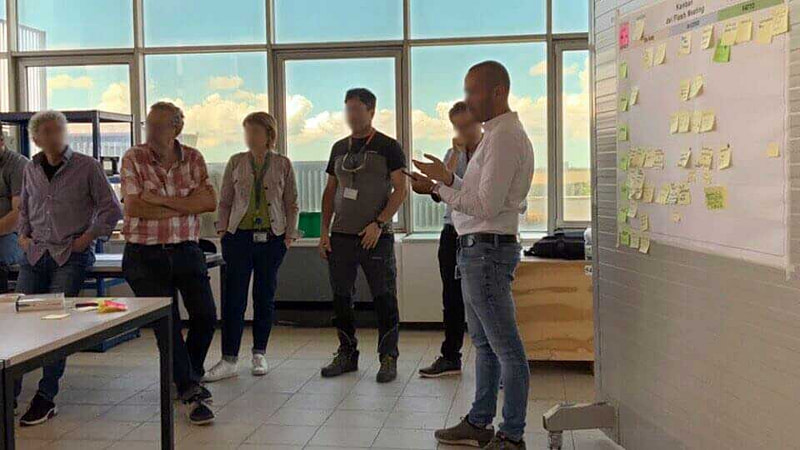
The agile approach is particularly well suited to these development activities, and a visual management mode with flash meetings was particularly functional.
Using flash meeting boards, which take inspiration from story mapping, lab teams break down the macro topics to be developed into micro-activities to be developed within the week.
This was a real success for the troubleshooting teams, who could then plan the necessary investigations to find unexpected failures of a part of the product.
Equally effectively, product assembly and testing teams have also been able to plan for support from departments outside the development team, whose services are essential to complete the product itself.
For the laboratory part, we have seen that the use of post-it notes on paper boards is very effective and immediate compared to the use of software tools.
The breakdown of work, and adaptive planning according to what emerges, drives the team into strong cooperation, leading technicians to step outside their domain.