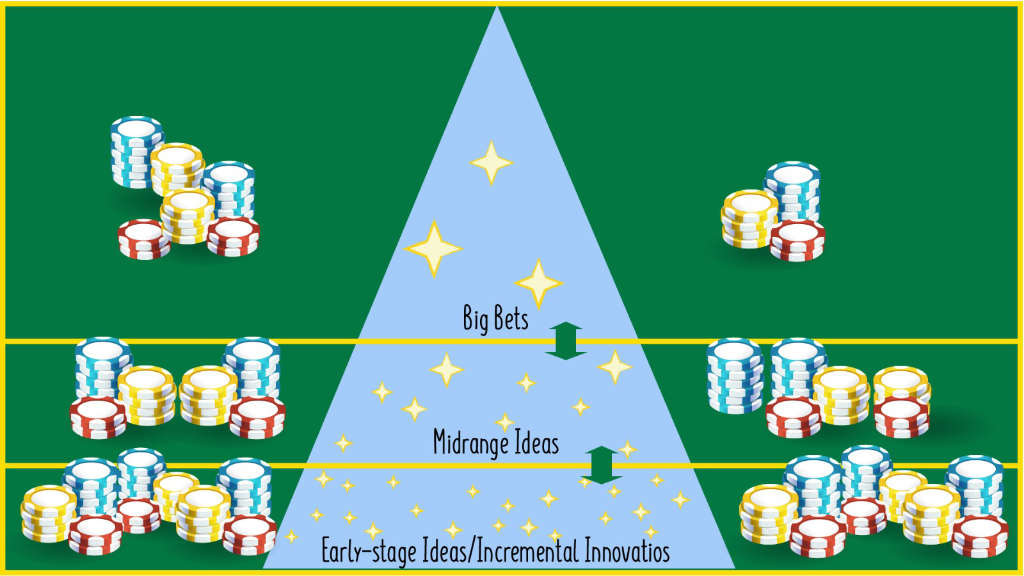
The business world, especially the manufacturing world, has always been very focused on Exploitation i.e., efficiency to give more efficiency or functionality.
Exploitation
As well, management schools and engineering schools have been focused for years on the search for efficiency and optimal solutions, in other words, Exploitation.
At the same time, the VUCA world in which we live is moving at high speed.
This is coupled with continued growth in technologies and the opportunities they offer.
To survive and thrive, in this highly dynamic world, continuous adaptation is necessary, which is only possible with people’s involvement.
Exploitation is suitable for a short-term perspective.
In other words, we think about continuity with existing business model by improving existing processes.
Products are innovated incrementally and are in continuity with existing products.
This approach can be very risky in the medium and long term because it can lead to the company exiting the market.
The management literature is full with such examples.
Just think, for example, of the case of Kodak, which failed to seize the opportunity of digital photography and therefore closed down.
Exploration
At the same time we are always hearing about innovation, which necessarily comes with exploring new things, that is, Exploration.
This can mean:
-
- Product innovation
-
- Process innovation
-
- Innovation in the ways of work
This involves accepting new ideas and realizing that they grow exponentially, working in teams and networks of people and teams.
Certainly art schools or design schools work a lot on this aspect.
In contrast to efficiency, in my opinion, exploration is not as much pursued in the world of product development enterprise.
Exploration is suitable for a medium- to long-term perspective.
This approach can be risky in the short term because not all exploration is successful.
It is much less so in the medium and long term because selection occurs in the early stages.
Companies have always been driven by these two strains of Exploitation and Exploration.
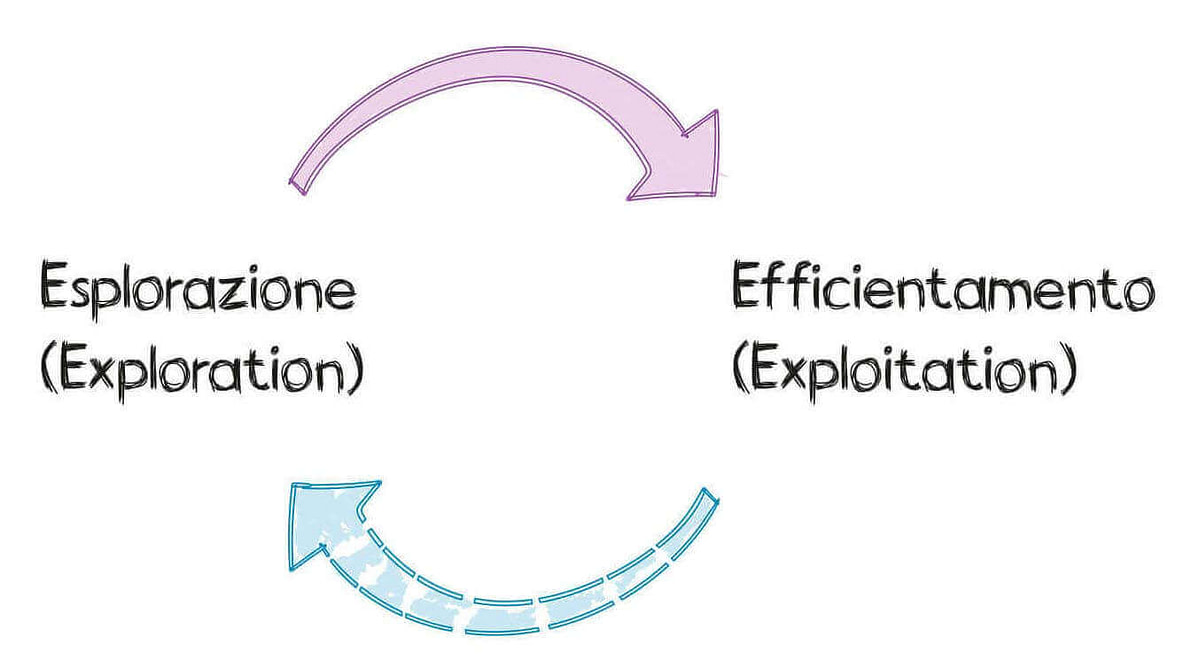
Successful companies skillfully balance these two tensions.
New business model
These companies are called bimodal or ambidextrous because they balance “doing things right,” versus “doing the right things”.Luca barboni

Exploration may require new business models, as I have experienced firsthand with my teams.
In fact, I remember very well a case I experienced when I worked in the company as a product development executive.
An Agile team of mine led by a very bright PO was developing a large-format 3D printing machine or LSAM (Large Scale Additive Manufacturing).
During the course of the project, the PO soon realized from talking to some potential customers that the “printable” parts were going to replace parts built with completely different technologies.
In fact, we are talking about a maximum print volume of 8700x3200x200 mm
Potential customers needed to be convinced that these parts were truly capable of replacing the previous components.
In this way, the business of direct sale of the machines, initially assumed, was not immediately feasible.
The company had to think about a different business model based on printing services for customers.
In this way, customers can quickly understand the advantages and limitations of the technology, and can evaluate the purchase of the printing press with more data.
The service of printing large-format pieces has become a new business mode in a short time.