A story about strange materials and strange uses of common materials in agile hardware product development. 3D printing materials, the unconventional samarium-cobalt permanent magnets. The innovative uses of common adhesive plastic films for 3D printing first state deposition.
In a recent conversation on LinkedIn, Valeria Burdi, an explorer of agile in education, asked me interesting questions about materials and their management.
The question is pertinent because the agility paradigm in the factory involves applying, even to the construction phases, agile approaches.
I summarize the stimulating questions that have been asked:
- Which materials are most congenial and most commonly used for rapid product development.
- What strange materials have we employed or what strange use have we made of materials born for other purposes
- What methods did we employ to handle these materials and store them. particular
Since 2014, I have actively participated in the Agile development of about 60 hardware products, and in particular machinery and other products for industry.
What I tell in response to the previous questions refers to this context.
Most suitable and most commonly used materials
The materials that we can consider common today are many such as various types of steels, light aluminum/magnesium alloys, and copper alloys.
The most common plastics are those for injection molding and thermoforming.
I mention in summary the multitude of trade components such as: electric motors and related drives, sensors, electrical and electronic components, valves and actuators that populate industrial products extensively.
Added to these are the materials, mainly plastics, that enable high-speed production of components with additive manufacturing.
As for less common or strange materials, I like to mention the design of a very large-scale additive manufacturing machine tool (Large Scale Additive Manufacturing).
At the time of its development in 2020-2021, this 3D printer for producing large components with thermoplastic materials was one of the largest in the world.
In fact, the 3D printing volume was 8700 x 3200 x 2000 mm.
The printer employs fused deposition additive manufacturing technique or FDM (fused deposition modelling)
This process uses thermoplastic technopolymers charged with carbon or other fibers as the 3D printing material.
These technopolymers are deposited in a pasty state, layer by layer, by an extruder to build the item to be printed.
In this specific case it was carbon fiber-filled ABS material, with mechanical strengths close to those of a light alloy.
The problem has been the fine-tuning of the 3D printing process.
It took several sprints for the cross functional team to find a qualitatively acceptable and economically viable solution of the printing process.
Strange uses of commonly used materials.
In this regard, the first printing layer is applied directly to the machine table, which must be heated to about 70-100°C.
In order to detach the printed material, a layer of material with dual function must be interposed:
- Promote the adhesion of the plastic bead
- Allow easy release of the molded part.
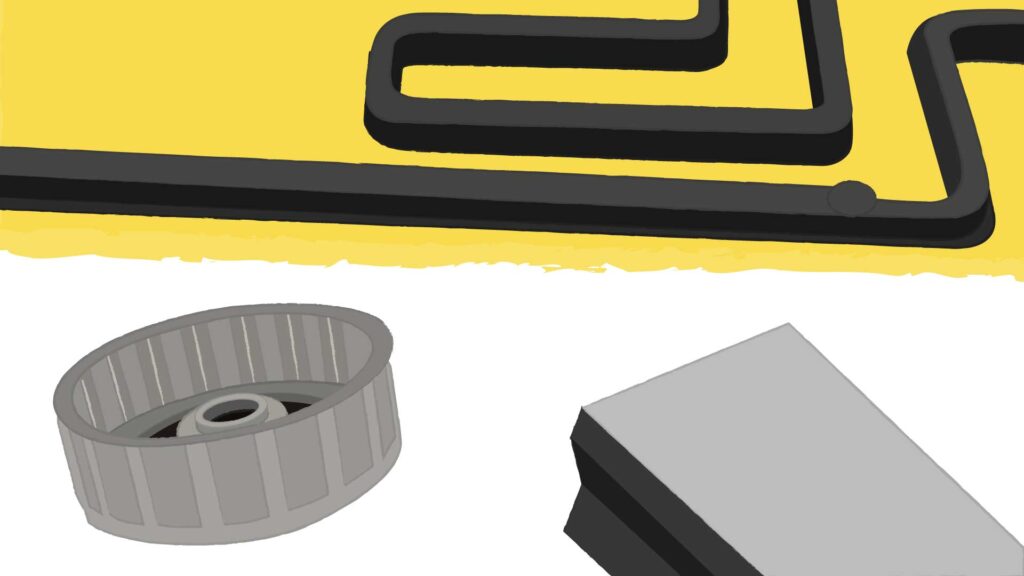
After several sprints, the development team identified an adhesive plastic film normally used for other purposes. And here is a strange use of a commonly used material.
Strange materials
A machine of this type extrudes material at about 200-250° C, and this requires isolating the other parts of the machine so that they remain at room temperature.
I remember well in this regard the search for a technology to replace the gear reducer interposed between the electric motor and the extruder.
This reducer requires cooling because it is coupled with the hot screw of the extruder.
The emerging technology of magnetic gearboxes or magnetic gears makes it possible to replace gears with elements equipped with permanent magnets.
This eliminates oil the cooling systems but you need to be able to work above 150 °C, where most permanent magnets demagnetize.
Therefore, it was necessary to identify a special type of permanent magnets containing the rare earth samarium, which together with cobalt allow them to work at temperatures of 250° C without demagnetizing.
I could go on with dozens of other examples of materials but, for reasons of space, I limit myself to these 3 examples.
Agile factory warehouses
Specific components created for the product are stored in dedicated areas.
In particular, all pretotypes, which are used to validate design solutions, are not coded like the products used in normal production.
In most cases they are retained for the time required to complete development or the retention time required by funded research projects.
This is then disposed of regularly.
The craftsmanship approach, which characterizes the agile factory paradigm, benefits from all good industrial practices.
In fact, standard materials are handled in the company warehouses that feed production.
The final product components are classified and then handled in the same manner as used for mass-produced products.